Words from Two of Asia-Pacific's
Most Respected Leaders
Mental Chess with AI carries forewords from Sreeram Iyer, Chief Operating Officer of ANZ Bank, and Roger Yeh, Founder of Raksa Insurance Indonesia, two leaders with a combined century of experience shaping organisations built to last.
Get the Book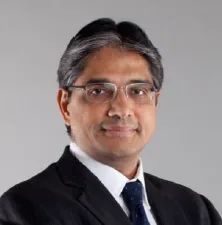
Sreeram Iyer
Chief Operating Officer, ANZ Bank
Singapore
"Know, Decide, Act is one unique book where AI doesn't work. It is meant for us, Humans. I wish such a book was published 30 years ago."
Sreeram Iyer
Foreword
I spent 31 years of my active International Banking career among two great Institutions: One nearly 200 years old, and the other 170 years old. I often asked myself what it takes to sustain such organisations for so long, well beyond the influence of individual leaders over the decades. When Keith presented the manuscript of "Playing Mental Chess with AI", I had the answer, and I had one regret: I wish such a book was published 30 years ago.
Over many a coffee session during weekends for nearly ten years, I have come to know Keith quite well. We explored, we debated, we challenged, and we discussed options. What strikes me most is the sincerity of his purpose, his beliefs in deep rooted spiritual truths from the ages and his deep listening skills, often breaking into that flashing smile!
Playing Mental Chess with AI is one unique book where AI doesn't work. It is meant for us, Humans. I read elsewhere that the world is witnessing a 40% drop in book-readership over the years. In that context, I know this one is very timely. Keith's book has an inspiring tone; it is a practical guide and is packed with sincere thoughts. With Keith, that should not surprise us. The most penetrating paragraph I read was when Keith shares his personal dilemmas in decision-making, and turns to God and the Bible, with a prayer for an answer. I found that touching, powerful, and sharp.
In Playing Mental Chess with AI, Keith does not complicate us with mere theory. With a higher laudable purpose focused on the Self, Family and Community, the book is rich with research, punched with practicality, and supported with frameworks.
The book can spark genuine satisfaction in each of us, provided we consciously blur the existing boundaries between personal life and professional choices. It commences with a focus on Values, and the role Values play as we face the many forks, options, and challenges in the road to decision-making. On these parameters, what matters professionally also matters equally in our personal lives.
Today's market pace is a clutter, if we allow it to be so. Keith cuts through this clutter with clarity, self-practice and authenticity.
To my own mind, the pendulum of a mindset chasing Individualistic glory has swung too far for too long. For greater good, we need to bring back the impact of our decisions on the larger community, starting with our families. This, according to me, is the Human Algorithm to work upon, and to do that, Keith's book is a powerful aide. This societal primacy is a concept legitimised over centuries (ironically) among all ancient philosophies. Right Thought followed by Right Action without any attachment to outcomes is a great reminder from our past. The emphasis is on right decision-making, rather than on Results. Let the results take care of themselves. Related principles of 'Know Thyself' feature in Stoic, Socrates, Confucian and many other great thinking. The concept of Dharma in Hinduism is also a stunning code developed millennia ago.
Congratulations on picking up this book. May you find in it, a way to live. I have.
Sreeram Iyer
Singapore, 2025
Roger Yeh
Founder & CEO, Raksa Insurance
Indonesia
"Keith's present book is a very valuable yet easy to read life guidebook. Even for older generations, the insights are still universally helpful."
Roger Yeh
Foreword
I have been honored that my dear friend Keith Carter had accepted to attend our Company Raksa's 50th Anniversary in Jakarta in August 2025, then asked me to write this Foreword. Keith seems to have a deep insight into our Company's cultures, and he describes well many aspects of our Company and our people.
Keith's present book is a very valuable yet easy to read life guidebook, in particular for younger generations embarking on a long career forward. But even for older generations, the insights are still universally helpful.
I do not repeat here Keith's words, and would like to introduce Raksa from my own 50 year perspective.
Raksa over the years has built a strong culture, like a high mountain glacier, slowly melting and flowing downstream, all the way to a river, then to the ocean, and our employees are imbibing these cultures all the way along this long river.
We are in business. We need Customer's Satisfaction. But it is obvious that Customer's Satisfaction cannot exist without Employee's Satisfaction.
Very early on, we realized that to achieve a genuine Employee's Satisfaction, we would need a twin component: Common Prosperity; Dignity.
For Common Prosperity, we started in 1983 a profit sharing system which runs well till now: This profit sharing is totally transparent, I allocate only to a few directors; then, the directors allocate to hundreds of employees, using a Performance Index updated and published to all every Monday. The final allocation in June is also voted by all directors in anonymous ballots, to avoid any personal bias.
Looking back, the Profit Sharing was a powerful achievement, as some senior staff having resigned 30 years ago still thank us for having made them prosperous.
The second component is Dignity: How to respect our employees, give them the genuine freedom to speak up without fear (always anonymously), give them all the chances to learn, relearn, and climb the leadership ladder. At our 50th, an award was given to Fernando, who had climbed to become a Branch Manager from his humble beginning as messenger, jumping more than 10 echelons.
We have now some very sophisticated building blocks well established to let our employees speak up, always anonymously.
First, we have a powerful whistle blower system (born in the toilets, called Toilet Box), where any employee can send now an email using an anonymous email address to denounce any misdeed up in the highest echelon. We require 14 days to investigate: If the case is proven, then the Whistle Blower can use a secret code and ask a friend to claim USD 300 cash from a law firm outside. This award can be much bigger if the potential loss is big. This is powerful, as in the last two years, two senior staff were asked to resign due to this Whistle Blower system. I think that all our staff believe now in the sincerity of this value.
We have also a Monday Score to ask if our employees are happy: If one single score is too low, it triggers a Tuesday Laundry, meaning all staff in this unit will write an essay to say why they are unhappy, all this in a totally anonymous way.
Any decision of the top management goes through a vote, and also a laundry for bigger cases, always in an anonymous way. We believe strongly in: "Power Corrupts; Absolute Power Corrupts Absolutely", quoted from Lord Acton.
In last two years, we have an in-house education matching the Indonesian insurance qualification exams, called Platinum Owl, consisting of 55 modules. I was impressed that many of our Misses Raksa in customer service, at age 19 or 20, have appreciated these exams as an opportunity for them to learn and climb higher.
Raksa's focus on Employee's Satisfaction can be a universal value in all human relationships, be they with family, friends, colleagues, or society at large. If we treat them with sincere humility, then any relationship would be harmonious. The recent book The Good Life by Robert Waldinger and Marc Schulz is an excellent reference.
Keith's new book is also an excellent life guidebook with this perspective.
Roger Yeh
September 2025
Ready to read Mental Chess with AI?
Endorsed by two of Asia-Pacific's most respected business leaders.